Most small businesses live or die on local search — someone types "electrician near me" or "best tacos in [city]" and picks from whatever Google shows them in the first few seconds. If your business isn't set up correctly for that moment, it doesn't matter how good your work is. You simply don't exist to that customer.
Here's the practical checklist we actually run through with clients — no fluff, just what moves the needle.
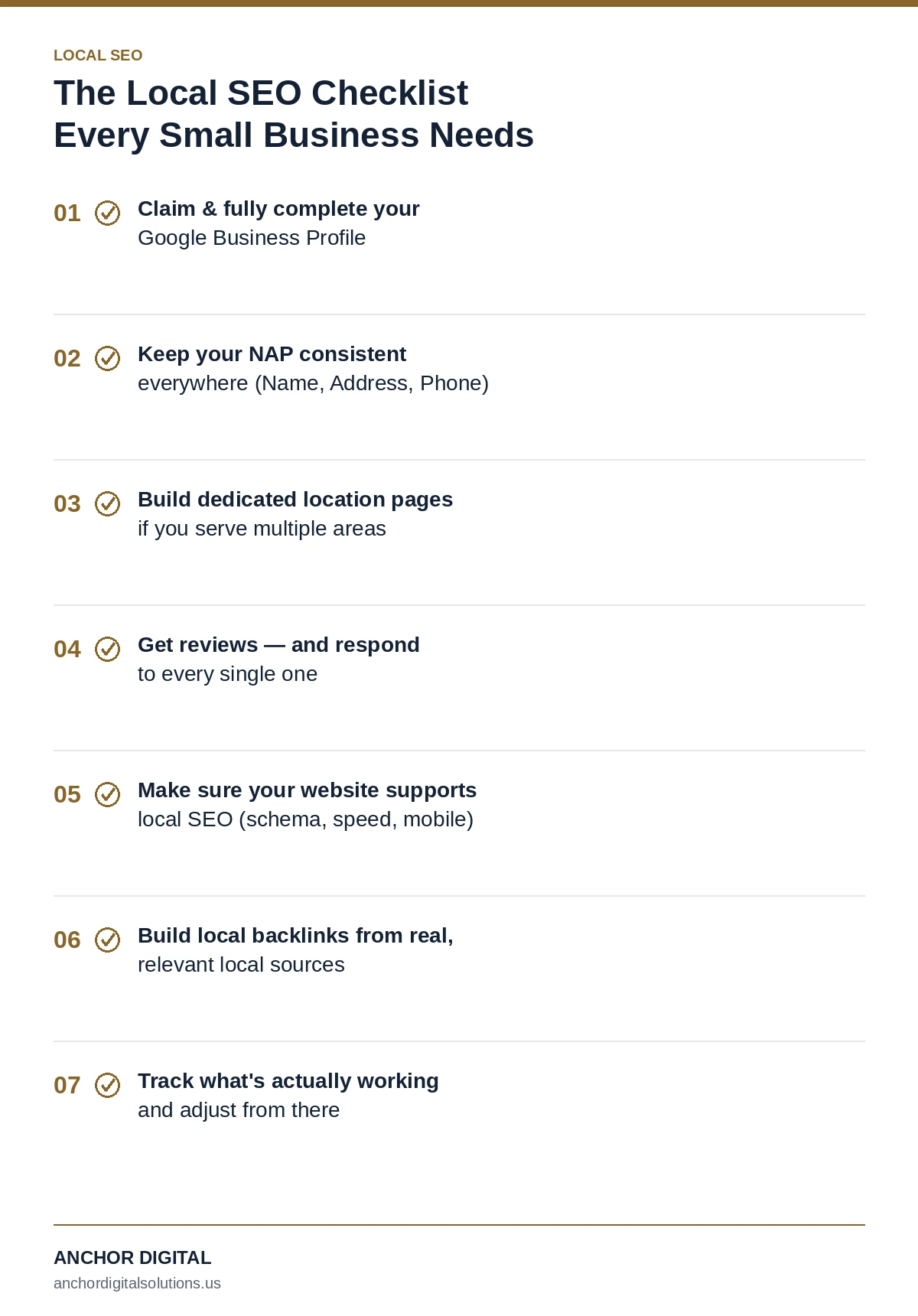
1. Claim & fully complete your Google Business Profile
This is the single highest-leverage thing you can do, and most businesses do it halfway. Fill out every section — categories, service area, hours, attributes, photos — not just the bare minimum. Businesses with complete profiles consistently outperform partial ones in the map pack, independent of review count.
Don't skip:
- Primary and secondary business categories, chosen as specifically as possible
- Real photos of your actual work, not stock images
- A complete, keyword-natural business description
- Regular posts — Google visibly favors profiles that show activity
2. Keep your NAP consistent everywhere
NAP — Name, Address, Phone — needs to match exactly across your website, Google Business Profile, Facebook, Yelp, and any directory you're listed in. "123 Main St Suite 4" on one site and "123 Main Street #4" on another creates confusion that search engines interpret as a trust signal problem, even though to a human it's obviously the same business.
3. Build location pages if you serve multiple areas
If you serve more than one city or county, a single generic "service area" paragraph isn't enough. Dedicated pages for each major area you serve — with genuinely different, locally-relevant content, not just the city name swapped into a template — give Google something concrete to match against local searches in each place.
4. Get reviews — and respond to every one
Review volume and velocity (how often new ones come in) both factor into local ranking. But the part businesses skip is responding — to the good ones and the bad ones. A thoughtful response to a negative review, visible to every future customer who reads it, often does more for trust than another five-star review would.
5. Make sure your website actually supports local SEO
Your Google Business Profile can only carry you so far. Behind it, your website needs:
- LocalBusiness schema markup — structured data that tells search engines exactly who you are, where you are, and what you do
- Your city/region mentioned naturally in page titles, headers, and body copy — not stuffed, just present
- Fast load times — Google factors page speed into local rankings, and slow sites lose people before they even see your info
- Mobile-first design — the overwhelming majority of "near me" searches happen on a phone
6. Build local backlinks
Links from other local sources — the chamber of commerce, local news mentions, industry associations, even sponsorships of local events with a website link — signal to Google that your business is a genuine part of the local ecosystem, not just a listing that showed up. These carry more local-relevance weight than generic, unrelated backlinks ever will.
7. Track what's actually working
Google Search Console and your Google Business Profile insights will show you what's actually driving visibility — which queries you're showing up for, where people are coming from, what they click. Most businesses set up local SEO once and never look at the data again. The ones who win keep adjusting based on what's actually happening.
Want a local SEO audit of your current site?
We'll tell you exactly what's missing and what to fix first — no pressure, no obligation.
Get a Free Consultation