Every small business owner asks the same question sooner or later: "Do I actually need a website in 2026, or can I just run everything through Instagram and Facebook?" It's a fair question. Social platforms are free to join, your customers are already scrolling them, and building a full website feels like extra work for something that "used to matter more."
Here's the honest answer, from someone who builds both: you need both — but only one of them is actually yours. Understanding that distinction is the difference between a business that's easy to find, trusted, and growing, and one that's quietly invisible outside of a single algorithm's mood on any given day.
You don't own your social media. You own your website.
Every post, every follower, every DM conversation you've ever had on Instagram, Facebook, or TikTok lives on a server that you don't control, governed by rules that can change overnight. Algorithms shift. Accounts get flagged, shadowbanned, or suspended for reasons that are never fully explained. A platform can deprioritize business content tomorrow and there is nothing you can do about it except watch your reach quietly disappear.
A website is different. It's a piece of digital real estate that belongs to you — no algorithm decides who sees it, no platform can suspend it, and no update can bury it under someone else's content. When someone searches your business name on Google, a real website is what makes you look established instead of makeshift. It's the difference between "we found their page" and "we found their business."
How a website and social media actually work together
The businesses that grow fastest online don't pick one or the other — they use each for what it's actually good at, and they connect the two on purpose.
Social media is your megaphone.
It's built for reach, familiarity, and quick trust signals — a video of your work, a review someone tagged you in, a behind-the-scenes look at how you operate. It's low-friction and highly shareable, which makes it excellent at getting your name in front of new people.
Your website is your headquarters.
It's where that attention converts into something real: a booked appointment, a submitted quote request, a completed purchase, a phone call. A well-built site answers every objection a potential customer has before they even ask it — pricing, service area, past work, reviews, credentials — all in one place, organized the way you want it presented, not however a social feed happens to display it that day.
When your Instagram bio links to a real website instead of nothing (or a generic third-party "link in bio" page), you're moving someone from a platform where you're competing with a thousand other posts for attention, into a space where you're the only thing on the page. That single handoff — social post to owned website — is one of the highest-leverage moves a small business can make.
The local visibility piece nobody talks about
Here's what a lot of business owners don't realize: a website isn't just a brochure — it's the foundation of how Google decides whether to show your business to people searching nearby.
When someone searches "photographer near me" or "plumber in Tampa," Google's local results (the map pack, and the organic listings underneath it) are built on signals that mostly come from your website: your business name, address, and phone number matching consistently across the web, structured data that tells Google exactly what you do and where, page content that actually matches what people are searching for, and site speed and mobile-friendliness, which Google directly factors into rankings.
A Google Business Profile alone can get you into the map pack, but it has a ceiling. Businesses with a real, well-optimized website behind their profile consistently outrank those without one, because Google has more to work with — and because a real website builds the kind of trust that keeps people from bouncing straight back to the search results.
Social media profiles, by contrast, carry almost none of this weight in local search. Google can't fully "read" an Instagram page the way it reads a website. If local visibility matters to your business — and for the overwhelming majority of small businesses, it does — a website isn't optional. It's the engine.
So what should a website actually cost in 2026?
This is where a lot of businesses get burned — either overpaying an agency for a bloated, slow-loading template, or underpaying for something so cheap it never really works. Pricing should track complexity, not guesswork. Here's a realistic breakdown of what different tiers should run:
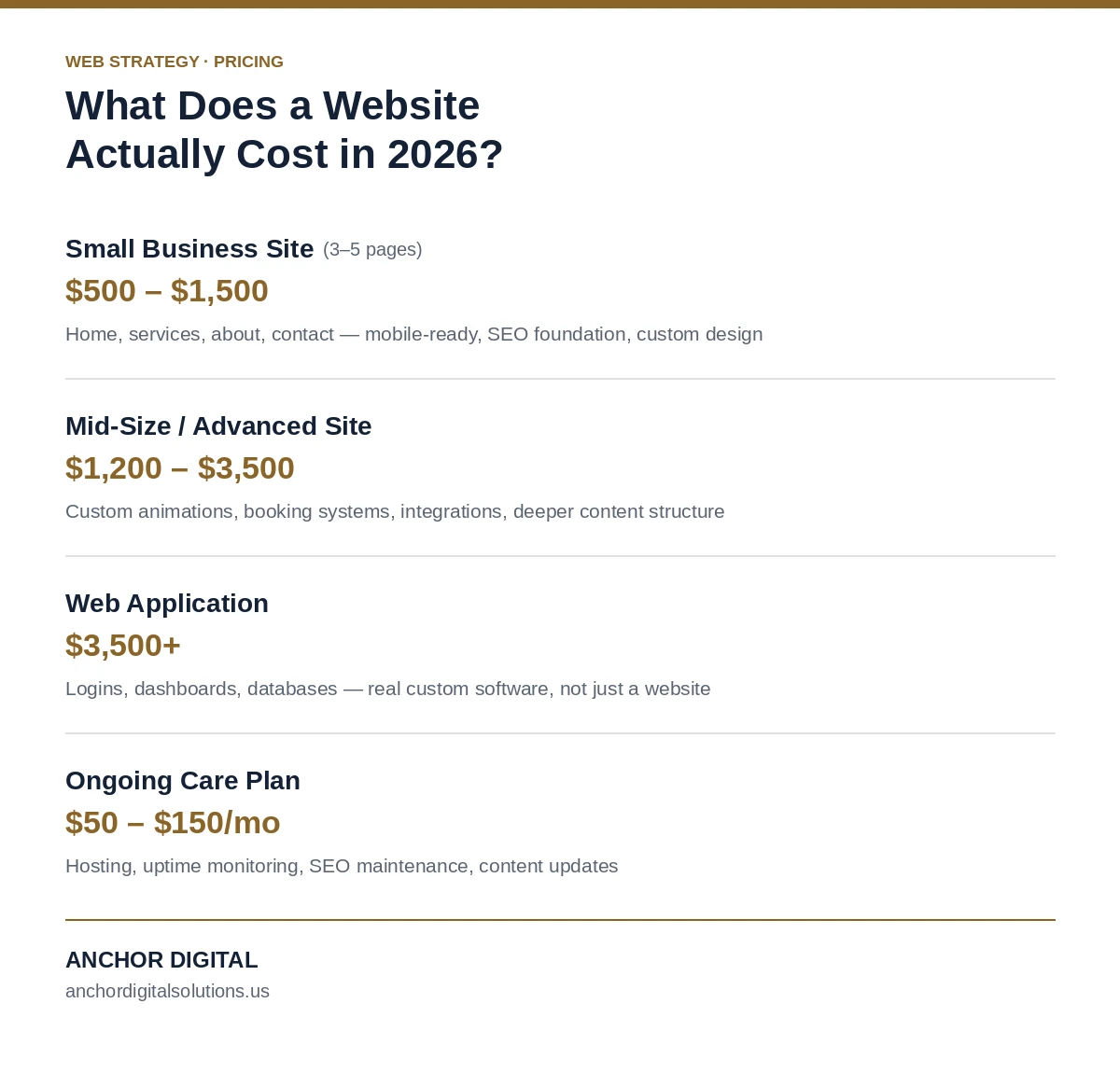
| Website Type | Typical Range | What You're Getting |
|---|---|---|
| Small Business Site (3–5 pages) | $500 – $1,500 | Home, services, about, contact — mobile-ready, SEO foundation, custom design |
| Mid-Size / Advanced Site | $1,200 – $3,500 | Custom animations, booking systems, integrations, deeper content structure |
| Web Application | $3,500+ | Logins, dashboards, databases — real custom software, not just a website |
| Ongoing Care Plan | $50 – $150/mo | Hosting, uptime monitoring, SEO maintenance, content updates |
What actually drives the cost within those ranges is rarely "how many pages." It's the amount of custom design work, whether the site needs to integrate with other systems (booking, payments, CRMs), how much content strategy and SEO work goes in up front, and whether you want ongoing maintenance or a one-and-done build. A cheap, templated site with no SEO foundation might save you money today and cost you every customer who searched for you and found a competitor instead.
The real cost of not having one
The businesses that skip a real website almost never notice what it's costing them, because there's no line item for a customer who searched, found nothing solid, and quietly moved on to the next result. That's the actual price of relying on social media alone — not a bill you get, but revenue you never see.
A website isn't a nice-to-have anymore, and it isn't competing with social media either. It's the piece that turns your social presence and your local search visibility into something that actually converts — the one asset in your entire marketing stack that you fully own, control, and can build on for years.
Not sure what your business actually needs?
We'll give you a straight answer on what it should cost and what it should include — no pressure, no sales pitch.
Get a Free Consultation