Ask ten small business owners what platform their website should run on, and you'll get ten different answers — usually whichever one a friend used, or whatever came up first in a Google search. WordPress, Wix, Squarespace, GoDaddy's builder, Shopify — they all promise the same thing: a professional website, fast, without needing to know how to code. The reality is each one trades off speed, flexibility, and long-term cost differently, and picking the wrong one can quietly cost you customers for years.
Here's an honest breakdown of what each actually gets you.
WordPress: powerful, but you're the IT department
WordPress powers a huge share of the web, and for good reason — it's flexible, has a plugin for nearly anything, and doesn't lock you into one company's ecosystem. But that flexibility comes with a catch: you (or whoever manages the site) become responsible for updates, security patches, plugin conflicts, and backups. A neglected WordPress site is one of the most common ways small businesses get hacked or end up with a slow, broken site nobody wants to touch.
WordPress makes sense when you want deep customization and are either technical yourself or paying someone to maintain it properly. It's a poor fit for someone who wants to set it up once and never think about it again.
Wix & Squarespace: easiest to start, hardest to outgrow
Wix and Squarespace are genuinely good at what they're built for: getting a decent-looking site online fast, with drag-and-drop editing anyone can learn in an afternoon. For a very simple site — a single-page portfolio, a basic "here's what we do" brochure — either one can be a perfectly reasonable choice.
Where they fall short is the ceiling. Custom functionality is limited to whatever the platform's app marketplace offers. SEO controls are more basic than a custom-built site. And if you ever want to leave, you're starting over — there's no clean way to export a Wix or Squarespace site into something else. You're building on rented land.
GoDaddy Website Builder: convenient, rarely competitive
GoDaddy's builder is often the path of least resistance since so many businesses already buy domains through GoDaddy and get upsold into the website tool at checkout. It's fine for the absolute minimum viable presence — but it's the most limited of the mainstream builders in terms of design flexibility, SEO depth, and performance. Sites built here tend to look and feel templated because, structurally, they are.
Shopify: the right tool, but only for one job
If you're selling physical products online, Shopify is genuinely excellent — inventory management, payment processing, shipping integrations, all built for commerce specifically. But it's the wrong tool if you're not running an online store. Using Shopify to build a service-business brochure site is like buying a delivery truck to commute to work — technically it'll get you there, but you're carrying a lot of unnecessary overhead.
Custom-built: more upfront thought, no ceiling
A custom-built site — real HTML/CSS/JS, or a framework suited to what you actually need — takes more thought at the start. There's no drag-and-drop template doing the thinking for you. But what you get in return: a site that's exactly as fast as it can be (no bloated page-builder JavaScript running in the background), full control over SEO structure down to the schema markup, and no platform lock-in. You own the files. If you ever want to switch hosts, developers, or design direction, nothing is holding you hostage.
It's also, contrary to popular belief, not necessarily more expensive. A lean custom site for a small business can come in at or below what a "premium" Wix or Squarespace plan costs over a couple of years, once you account for the platform's ongoing subscription fees.
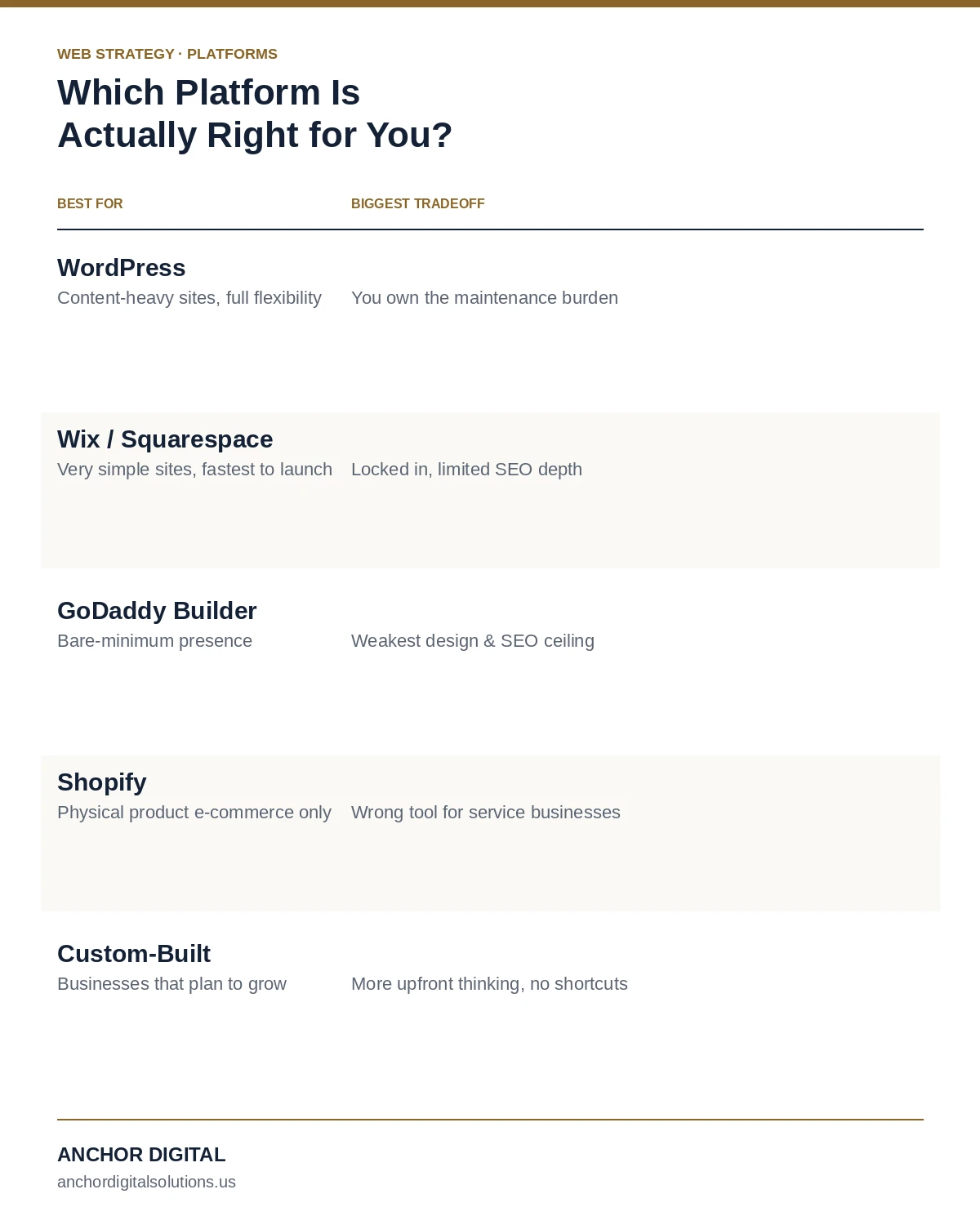
| Platform | Best For | Biggest Tradeoff |
|---|---|---|
| WordPress | Content-heavy sites, full flexibility | You own the maintenance burden |
| Wix / Squarespace | Very simple sites, fastest to launch | Locked in, limited SEO depth |
| GoDaddy Builder | Bare-minimum presence | Weakest design & SEO ceiling |
| Shopify | Physical product e-commerce only | Wrong tool for service businesses |
| Custom-Built | Businesses that plan to grow | More upfront thinking, no shortcuts |
The real question to ask
It's not "which platform is best" — it's "what does this business actually need in two years, not just this week." A food truck that needs a menu and a phone number probably doesn't need a custom build. A service business trying to rank locally, convert leads, and scale its content over time almost always outgrows a page-builder faster than expected — usually right around the point where changing becomes painful and expensive.
Not sure which path fits your business?
We'll give you a straight answer — including when a page builder is genuinely the right call.
Get a Free Consultation